Building the Canada–Africa legacy: Sam Alonge at Africa Accelerating 2026 — full session, photos and transcript
Storspay’s founder joined 369 Global’s Muraly Srinarayanathas and the Canada-Africa Chamber’s Garreth Bloor in Toronto on 7 October 2026 to discuss what it takes to build durable Canada–Africa trade — why the plumbing matters more than the programme, the $15 billion corridor, and the first-year playbook for Canadian CEOs. The 37-minute video, the photographs, ten short clips and the complete edited transcript.
Read this guide in Français
The short version. On 7 October 2026, Storspay founder and CEO Sam Alonge joined Muraly Srinarayanathas, Chairman and Co-Founder of 369 Global, for Session 2 of Africa Accelerating 2026 — “Building the Canada–Africa Legacy” — moderated by Garreth Bloor, President of The Canada-Africa Chamber of Business, at Goodmans LLP in Toronto. Below: the full 37-minute session on video, the photographs, ten short clips, and the complete edited transcript in English (lire en français).
Watch the full session on YouTube (37 min, subtitles in English and French) →
What Sam argued, in five lines
- Canada–Africa trade is about $15 billion a year. The target is $30 billion — and it will be reached in transactions, not announcements.
- The friction is the plumbing: fees of up to 13%, failed payments and week-long waits are what stop a second order from following the first. Storspay was built as that plumbing, first for RxAll’s own operations and now for every counterparty that trades between Canada and Africa.
- Risk is a perception. The investors who said no in 2016 are saying yes in 2026 because the transactions became visible.
- The first-year playbook for a Canadian CEO: one market, one partner, hire local, use the diaspora — and measure the mission by the transactions it produces.
- Legacy is what the second transaction looks like: easier, cheaper and faster than the first.
Photographs
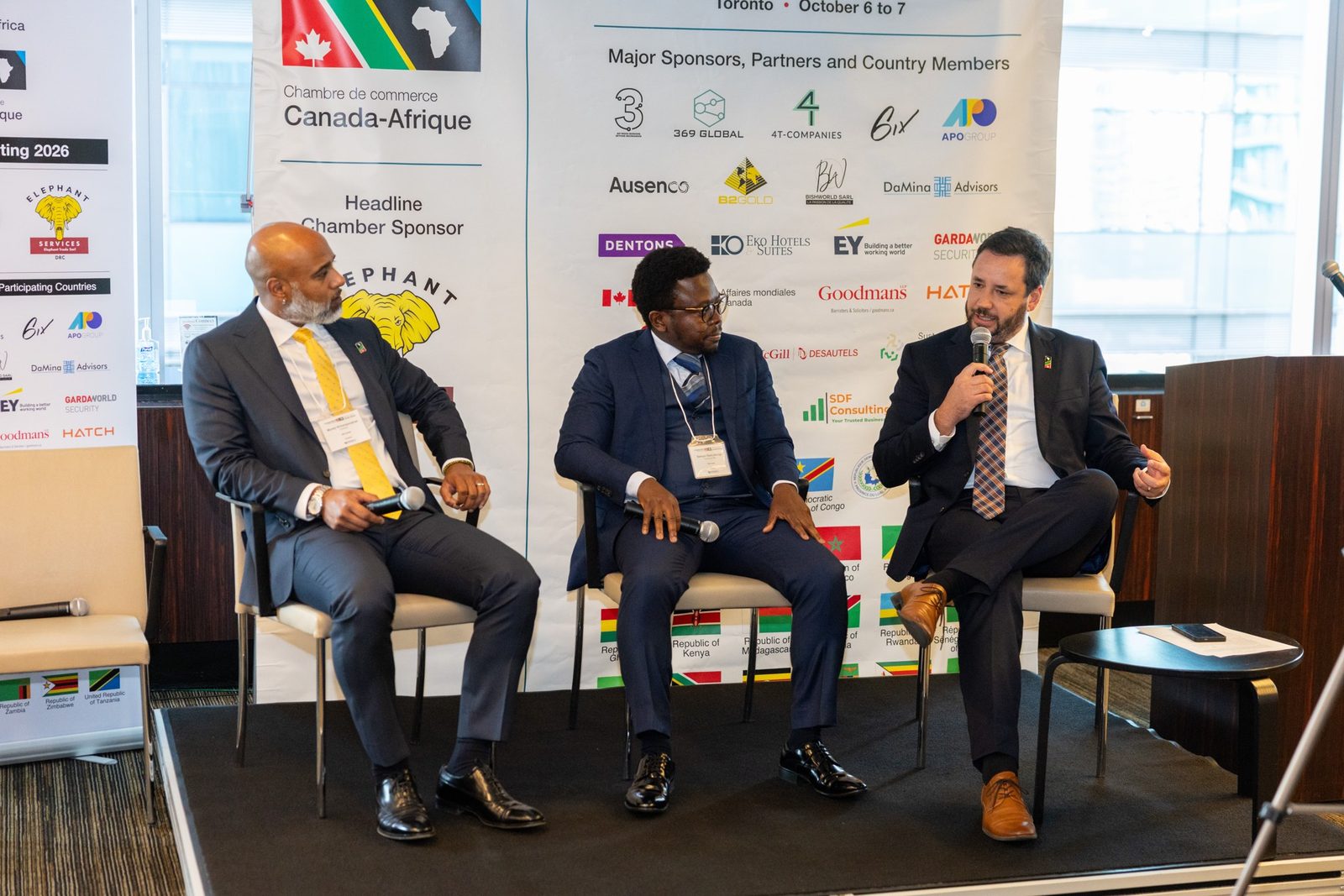
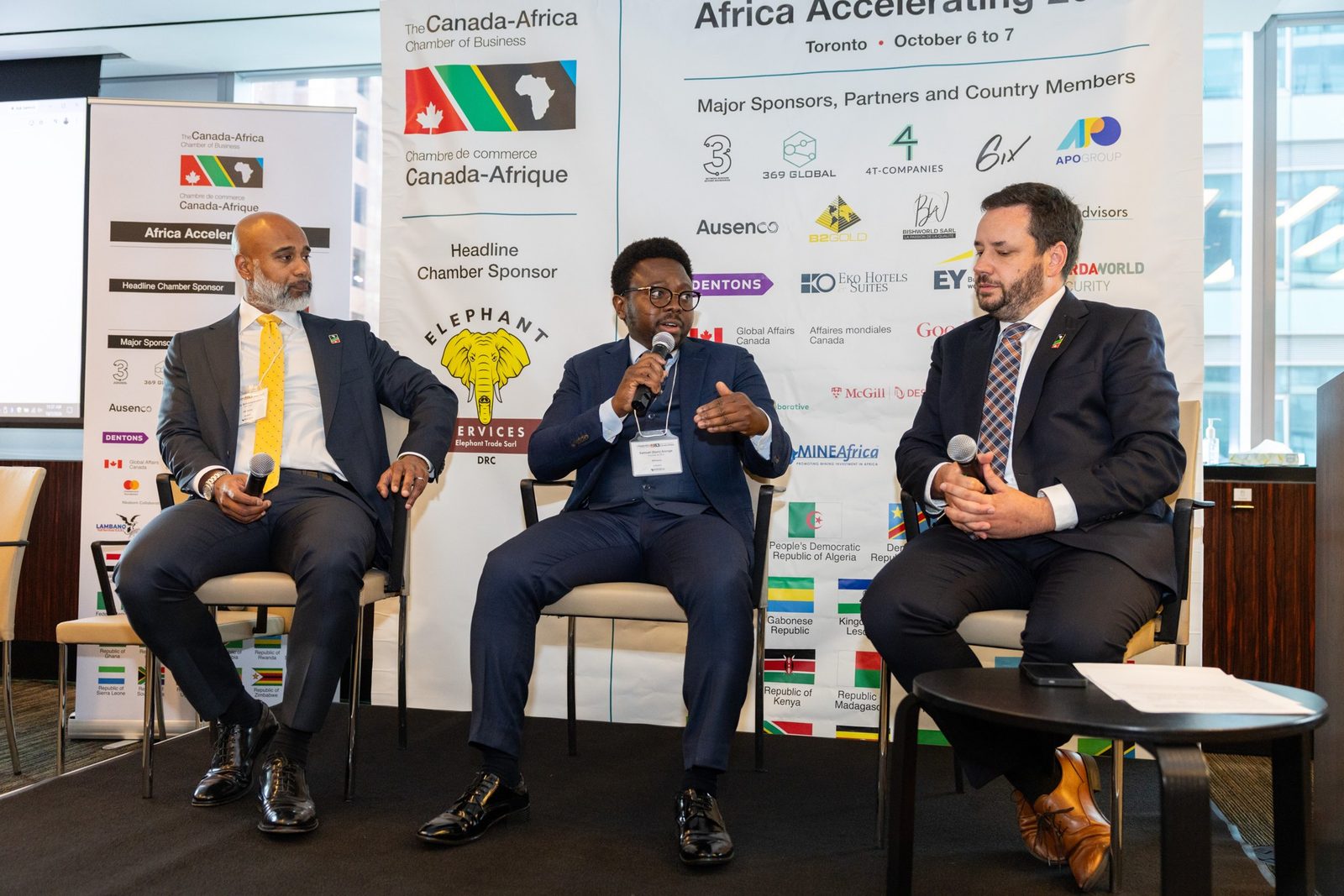
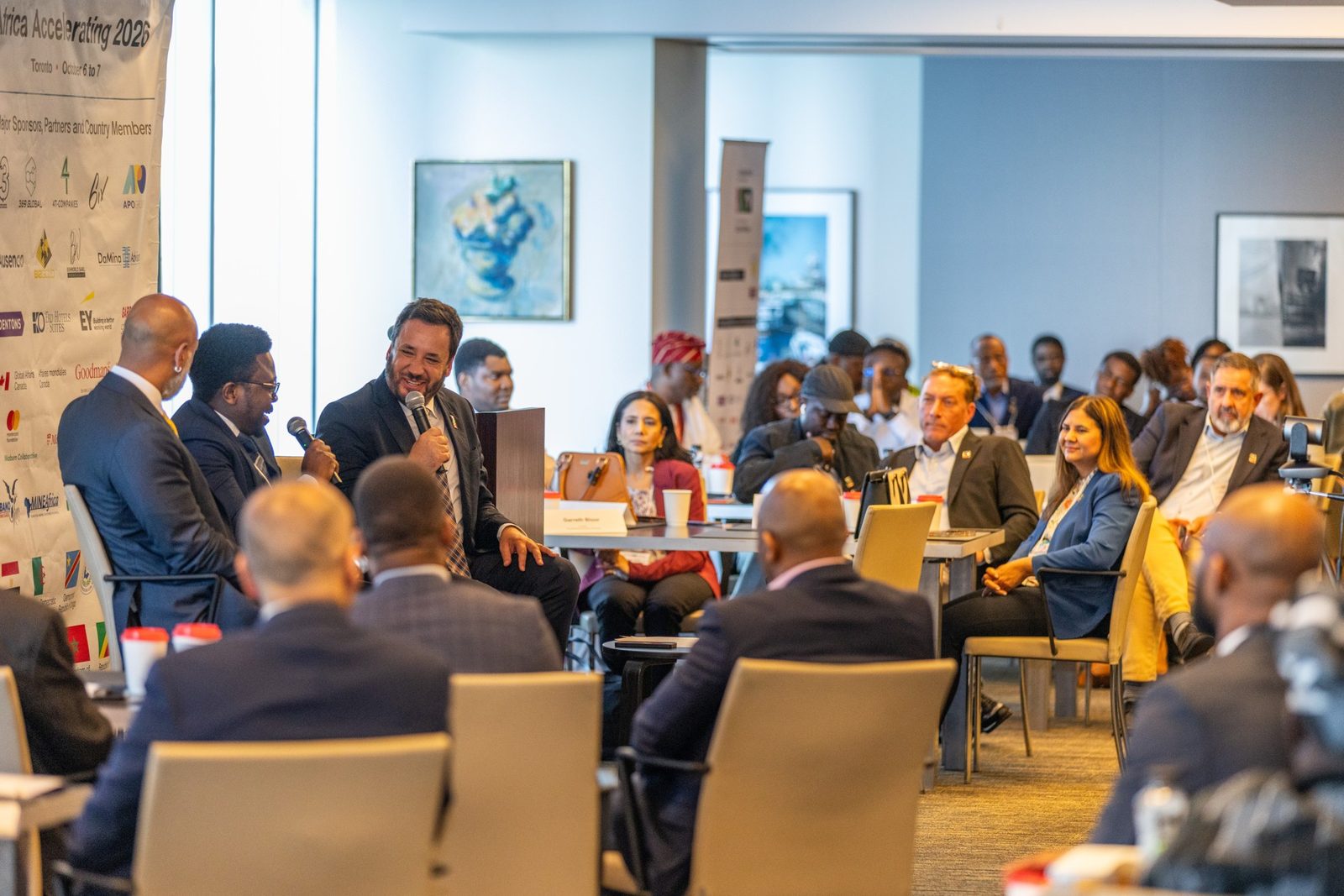
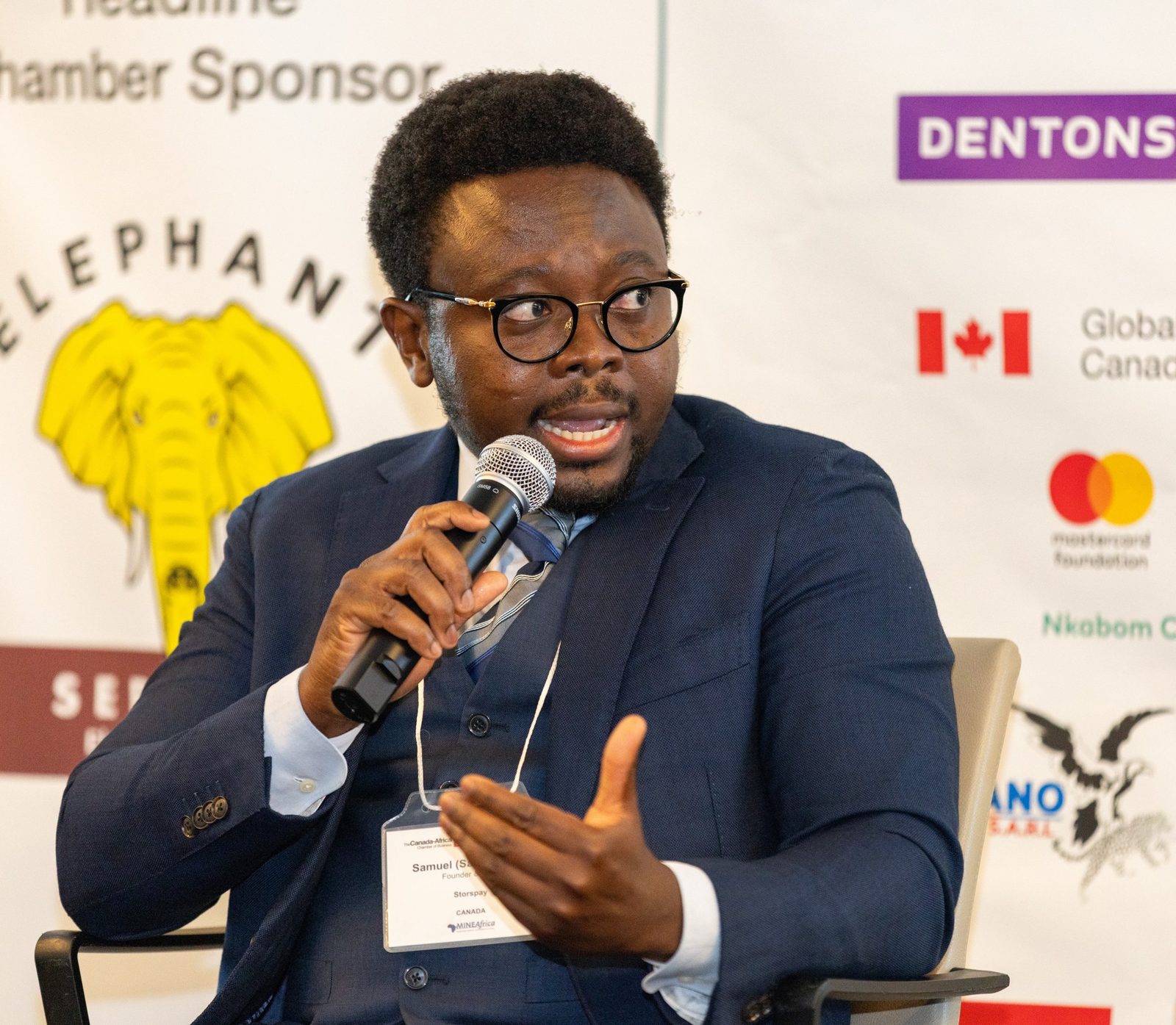
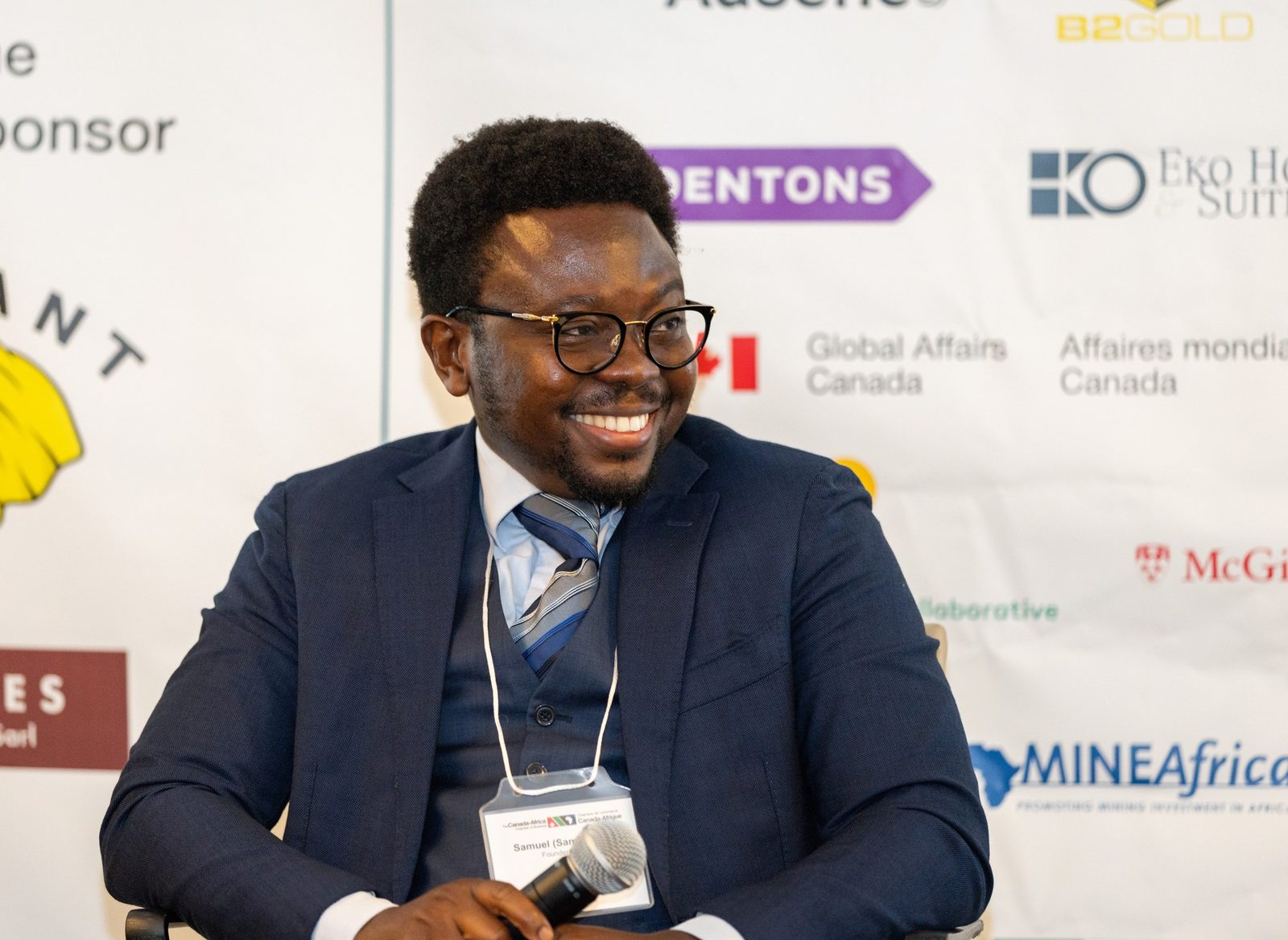
Ten moments from the session
Short clips cut from the recording, each under a minute.
The session, in full — edited transcript
Lightly edited for readability: fillers and repetitions removed, nothing added. Timestamps refer to the YouTube recording. Panelists: Garreth Bloor (moderator), President, The Canada-Africa Chamber of Business; Muraly Srinarayanathas, Chairman & Co-Founder, 369 Global; Sam Alonge, Founder & CEO, Storspay.
00:06 Framing legacy
Garreth Bloor: The title of this panel really focuses on legacy, and the reason we opted, as we created the programme, to take that approach was that legacy is something that is considered over the long run. But there’s so much that happens every day in your businesses, quarter by quarter, day by day. The discussion today is, first and foremost, to go through what it is you’re doing, how you’re transforming and accelerating the trade relationship we’re all discussing here, from the highest levels of government to the leading boardrooms, but then to go down on what that means for each one of you.
And so, Muraly, if I may begin. We spent time together at a VIP trade and investment dinner with the Canadian government leadership in Nairobi, and you were there to launch 3 Magazine, the latest venture out of a number of ventures that you’ve had across your career. Just to recognise you: you’ve built significant educational capacity here in Canada, and you’ve taken that and created international partnerships. So I just wanted to run through, in that context, how you frame your day-to-day work, what that work is, and what that looks like in legacy 30 years from now, as a 30-year-old organisation that we are today. Muraly.
01:11 Muraly Srinarayanathas: global thinkers, education and media
Muraly Srinarayanathas: Thank you, Garreth. And thank you, Sam, for joining me on this, and all of you for attending today. Really interesting conversations. I’ve really appreciated the panel speakers and some of the insights.
When I think about legacy, at 369 Global we are focused on this: there are many global challenges in the world, and it is going to take global thinkers to address those global challenges. People who have the ability to have conversations between cultures and beyond borders. So at 369 Global we focus on those global thinkers. How do we think about education for them? How do we think about information, in terms of media, for them? And, I think most importantly, how do we think about activating them, encouraging them to take on these global challenges?
So on the education side, as Garreth mentioned, we focus on our vocational training here in Toronto. We’ve also started doing this in Kenya since 2023, on the healthcare side and cyber security, and in India and the UAE. And on the media side, and hopefully many of you get a chance to grab a copy, is 3 Magazine. We do print, digital, podcast and events.
I think the previous speakers, and many of the conversations I’ve been hearing here, are about some of the success stories that people have not heard. And I would ask you to consider: you might know some success stories in your own industry and your own space, but do you know the success stories outside of your space that are happening with Africa and Canada? I don’t think that there’s a lot of information there. There are a lot of success stories, but are you hearing that? I don’t think so. These are global connections, global opportunities, that are taking on global challenges. And through the magazine we are telling those stories, through these podcasts, through these educational partnerships. We’re building the relationships, as one of the panel guests said, that are really going to help create these global conversations to address these global challenges.
03:40 Sam Alonge: the $15 billion corridor and the cost of friction
Garreth Bloor: Fantastic, thanks Muraly. Sam, from your perspective. We know you as a serial entrepreneur, and I’ve got to admit, when you emailed us about your latest venture I had to check if it was really you, because this is an innovation and a company, and we had a session with you just two weeks ago for members, that is really dramatically redefining the landscape when it comes to payment solutions and immediacy. So I’d like to ask you to take us through what it is that you’re doing with the latest company, and then perhaps, as you look at the room and you think about the partners here, such as banks and others, how do you view these natural partnerships for next steps?
Sam Alonge: Thank you, Garreth, for the platform, and it’s nice to be here with you, Muraly. At Storspay, primarily, we’re focused on enabling North American businesses to pay and receive money from partners mostly in the Global South. So across Africa, that’s where we have most of our concentration today, but also in Latin America and Asia as well.
Before I go into why I started this latest venture, I want to start first of all with the macro level. If we look at it in the context of the conversations we’ve been having here for the last couple of hours: Canada–Africa trade at the moment is about $15 billion a year, growing about 30% every five years. And we’re seeing a significant influx. The first time, when I moved here into Canada, you didn’t see this many Africans in Toronto itself. And now we have over 1.3 million Africans here in Canada.
So at the top level, the question now is: if we’re going to facilitate trade, because we have most of the people here, and also because of our own need as Canada to diversify our trading partners, under what rails will that run? We had recently the announcement of the air flights going on between Nigeria and Canada, and Abidjan and Canada as well. But when it comes to payments, most of the payments are still running on the 1970s correspondent banking.
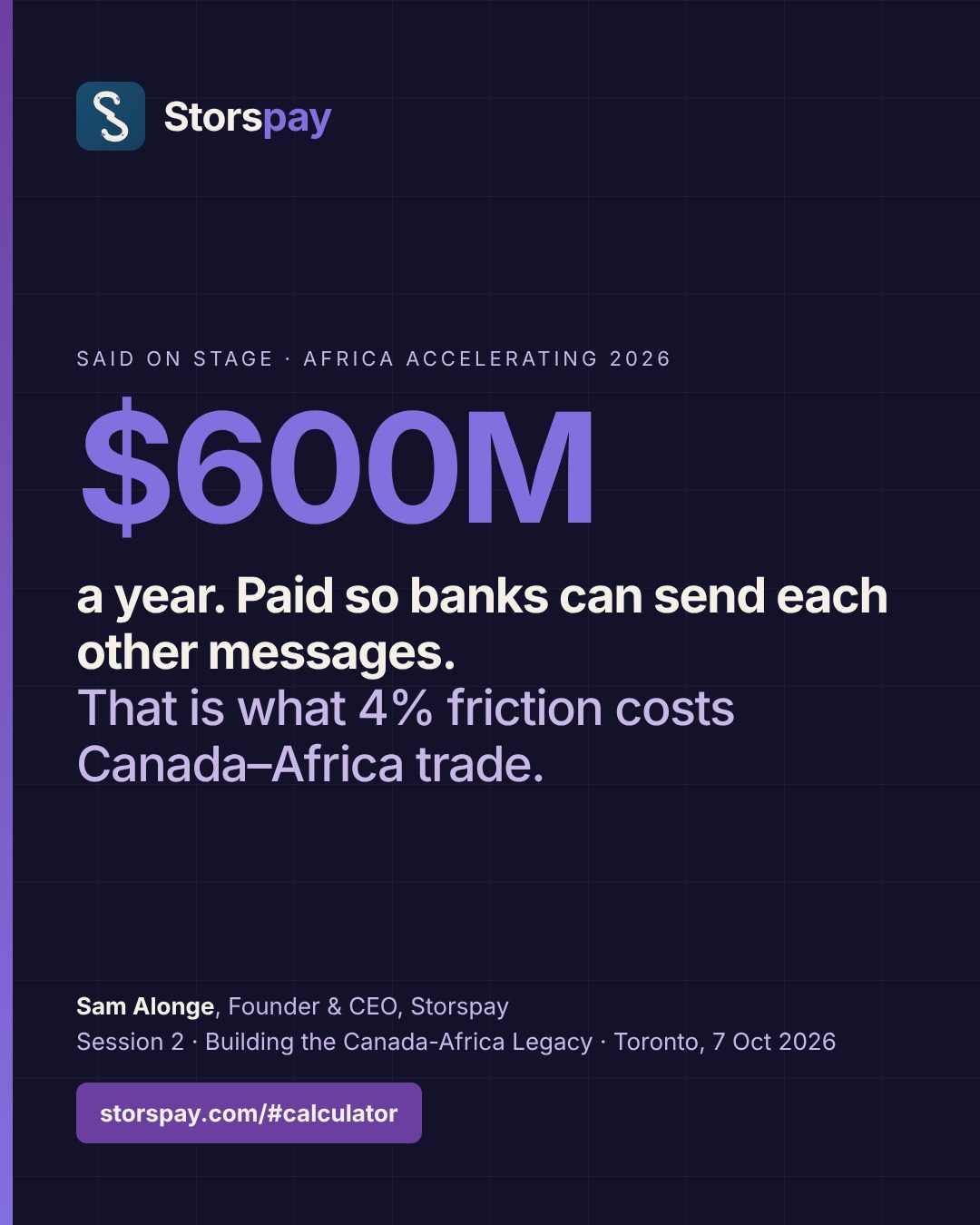
We’re talking here of about 4% on average, let’s just make it easy, 4% is lost to friction: correspondent banking fees, SWIFT fees. On that $15 billion, that’s about $600 million that a Canadian company can hold in its pocket, and its African counterparty can keep in its pocket, that’s been paid out just for banks to send messages to one another. So that’s the cost of the friction.
But the most important thing, if you take that out from the economic transaction itself and look at it from a trade perspective: how do Canadian companies get paid back? That’s the question. What I just told you about 4%: it’s easy for a Canadian company to pay into Africa, and you pay that 4% commission fee, not looking at the fixed fees that the local banks here would charge you and would also charge the recipient. But how do I get my money back from Africa? In many of the African countries, because of the illiquid markets, FX is very hard to procure. Sometimes it can take you one to two weeks to get the counterparty to pay you back, and the expected amount that is meant to land in your Canadian bank is always shortened because of the fees along that line. So that is the macro, and that’s the impact of the friction when it comes to Canada–Africa trade.
For me personally, my first company, we ran it across 19 countries in Africa. I had team members, and some of them you met in this new company in Nairobi the last time you went, and I had to pay them from either the US bank account or the Canadian bank account. And it was the same issues. 4%, and in some countries in East Africa, like Ethiopia, sometimes 13% in fees lost before the counterparty actually receives the funds. And sometimes the wires don’t even land. I have to have it repeated again, and sometimes even just cancel it completely. And it destroys the trust, when there’s a payment that needs to be made on a Friday and you haven’t done it, and your colleague in Africa is asking you, “Where’s my money?”
So for us, we built Storspay internally as that plumbing to enable those transactions to happen. And we have now productised it as its own company, to also serve all the counterparties in Africa that are doing trade. If you’re paying a freelancer in Africa, you’re paying a supplier in Africa, an employee, a partner in Africa, you can use our platform and in under four, five minutes it settles with the correspondent party. We have freelancers today that use the platform who don’t even bother about settling into a local currency. They hold US dollars, British pounds, and they have a debit card against that that they can actually issue.
08:42 What legacy looks like inside a business
Sam Alonge: So, in sort of finalising my introduction: when we look at it from my own perspective of what that means long term, it really means that if more companies can actually trade, because they can make a payment instantly, and a local counterparty in Africa can use that money to hire someone else the next week, or to actually buy more goods and services to export back into Canada, and the Canadian companies are not afraid that there’s a fraud risk of them having supplied a good and not having the payment back, then as a result of that we can grow the trade between Canada and Africa. That is what the future of a success and legacy would look like from my own perspective.
09:24 Making the case for Africa
Garreth Bloor: Brilliant. Muraly, in building that legacy, what I really respect about individuals like yourself: there are those of us who have a connection to the continent, and then there are those who look at the world as it is and say, well, this is where the future is. How do you, as a leader, as a CEO in a company that’s got a global presence, redirect and make the case for Africa? And in terms of that narrative, I know what you’re seeking to do is not to change the narrative; it’s to recognise reality as it is and bring others up to speed with the truthful reality. So just talk us through, because, and I say this in the context of us speaking to bank CEOs in Canada who, I think, are moving in a direction of seeing what Zenith already knows and others know, what do you say as we bring Canadian companies and teams into the forefront of this Canada–Africa trade and investment relationship?
Muraly Srinarayanathas: That’s an easy question, no? Look, when I was in Kenya just recently with you, Garreth, I also attended a business conference of local African business owners as well as some foreign investors. And many of them said, you go into these countries having a certain perception, and people come with this attractive product or service, but first and foremost you have to understand the market, and you have to listen and learn. And so many of them said they had this idea, especially those foreign investors that came in; they had this idea, but it was like five years later that they actually had the right product that was of interest to the market.
And I think there’s also, if I may, this generational divide. I’m 47, so I feel like I’m in the middle somewhere there. But I think there are a lot of folks that are working with traditional financial institutions, or what have you, and then you have things like what Sam is doing, cross-border payments, that seem like a no-brainer, especially for a lot of gig workers, which is a huge generation that’s tapping into that. And that generation cannot understand why these big institutions that have the money are not moving fast enough. And I think the same thing about innovations that are happening in Africa. M-Pesa in Kenya is another example of a hugely innovative product, and then to have someone come to Canada and then have to do a wire? It’s so nonsensical. And then we have the audacity to say, “Where is your Canadian experience?” to many of these people. “Where is your global experience?” I would counter with that.
So I think our interest in Africa: I was privileged and lucky enough, because of the support I had growing up in Canada, to also be able to work overseas, and that really opened my eyes to the innovation and the things that were happening. I think North America thinks it is the world. And then I went to the actual world and found out the exciting things that are happening. And Africa is one of the places that has the youngest population, and just with the infrastructure, and sometimes the opportunities of infrastructure, it forces innovations. Innovations that can be applied here in Canada. And I want to be a part of that. I want to be involved in that energy. I want to support those businesses and see the talent. My first step was in Kenya, and I haven’t been everywhere in Africa; Kenya, Rwanda and South Africa are my current experiences, but the talent is absolutely tremendous. And being in the education space, being in media, I want to be plugged into that.
13:40 Raising capital then and now
Garreth Bloor: And congrats on establishing firm roots, starting with Kenya. It’s absolutely awesome. Quick question, so maybe not that quick, Sam. If I could just deviate slightly from the business itself to your experience financing this business and getting backing. Is it correct to paraphrase a discussion that you had with us about a month ago to say that when you went in front of venture capitalists and early-stage investors here in North America, they said, “We love what you’re doing, but can you focus it on a market that we’re more familiar with?” And obviously your answer is no, this is the market where the future lies. But can you talk us through that experience, especially for those looking to raise capital or co-raise capital for ventures in North America, whether they’ve been new African entrepreneurs who’ve been welcomed into Canada, or individuals who are setting up subsidiaries here but remain on African soil, running their headquarters from there?
Sam Alonge: Yeah. The first company was far ahead of its time in terms of AI. We started that just as I finished college in the US, about 10 years ago, and we built the world’s first AI spectrometer for quality checking. It was within the context of raising for that in San Francisco that the Americans told me, “Hey, we love what you’re doing. This is far ahead of its time. Do it here in the US. What are you doing in Africa? They don’t have any money.”
But circling back 10 years after, with Storspay, the conversation is slightly different. It’s actually easier to raise money now. I was able to raise funding for this in New York, because the Africa story is an easier story now for the capital space here. And obviously I expect it to get better, especially with the IPO that Dangote recently did, and the broad macro stability of the last 10 years: efficient democracies, repeat democracies in terms of elections, less broad conflict on the ground, successful bond raises across several sovereign markets. So I’ll say for many immigrants who have moved into North America, it’s actually easier now than it was 10 years ago to raise capital.
And that process, when it comes to the integrity of that process: at the end of the day it’s typically the size of the market. For North American investors, it’s not so much any more about the counterparty risk or the sovereign risk. I think there’s enough information now amongst the investing public here in North America about how to price that risk in Africa. So mostly, at the end of the day, when a VC is looking at whether this makes sense or not, the question is more about the size of the market. That’s the first thing.
Then the second question they would typically want to go down on is your retention. Because if you just end up with one transaction per time, and that one transaction takes another 30 days, 60 days, it’s not really very interesting from an economic perspective for the VC investments. It’s different if you’re going with the more growth-scale investors, but VC investors are looking more at growth: how fast can you actually grow the business so they can exit to the next investor? So part of what they’re looking at there is your retention economics. How many people who did the first transaction are doing the second one, and what’s the velocity of that? Being able to provide at least some of that economics for a minimum of six to 12 months, that’s typically the information they need.
And then lastly, finding the best accelerators out there that can support you. My first business, I was with SOSV, the world’s leading hardware company, and with them I went to China to build the first prototype of the hardware. With Storspay, I was with Techstars in New York, and we got JP Morgan investing alongside them into us. So really having that sort of counterparty investor network through the accelerators, that would help open doors as well.
17:46 Advice to Canadian CEOs entering Africa
Garreth Bloor: Brilliant, and that’s amazing to see, just the last 10 years in the trends you’ve observed. Number one, great for legacy, but two, bucking some of the general trends, where we’re hearing conversation that’s not specific to Africa, speaking about financing sometimes becoming more difficult. But clearly that’s not the direction on the Africa file in your experience.
Muraly, true to the name 369 Global, you’ve got a very macro view, and I know you’ve been a key part of many trade missions in Africa and in the Asia-Pacific region. I think Canada’s deepening trade ties and the massive accelerated growth, let’s say, in the recent past 10 years has been noteworthy by many. But clearly the trend and the possibilities are in Africa, and you’re at the forefront of that. From a legacy perspective, what does business need to do, because government has already spoken in detail on this, what does business need to do to realise this opportunity? And what is the advice that you give to the CEOs who didn’t come today, who are behind the curve, as all of us would argue, when it comes to actually ensuring the success and growth of their companies anchored in trade with the African continent?
Muraly Srinarayanathas: Why would I encourage them to go to Africa? Is that it?
Garreth Bloor: Yeah, what are the key things you tell them behind closed doors?
Muraly Srinarayanathas: Behind the closed doors, on this open forum. OK. Definitely, it’s the understanding of long-term commitment. In any market that you go to there are going to be challenges. You need to pivot, and entrepreneurs should know that. Going to Africa, or any other country, you have to understand those dynamics. But if you look statistically at demographics, at innovation, if you’re not in Africa you’re not doing global business, in my opinion. And the young talent there, again I’m going to emphasise, is innovative. Nations are talking about this entrepreneurial energy. It’s in Africa. So if you can tap into that talent, and again, listen on how we can support these innovations.
Sam brought up that someone poached him and brought him to the US. And if I can be so bold, Sam was diplomatic about North American investors, but the Canadian investment and VC space is horrendous. Is horrendous. And I think there are opportunities for growth there for startups that are doing business here in Canada but also looking to do business in Africa. Because, as government has been talking about, and Prime Minister Carney has really been pushing forward on, which I very much align with, is tapping into our diaspora and using them to establish these global trade partnerships. So that goes back to investment in our diaspora organisations.
And maybe I’m being a little bit harsh. Canadian investors are keen to do that, but we need to move a lot faster. We have competitive term sheets that come, but they take too long. We need to move fast. The US moves fast. They’re quick to support you financially, and they look for great talent. In AI, quantum computing, all of the research and the talent is in Canada, but the commercialisation is missing. So I think finding the right partners as you go into these markets is also important, because you can’t go alone. Local partners, financial partners, I think are quite critical. Hopefully I wasn’t too bold, Garreth.
Garreth Bloor: No, this is an Africa–Canada forum. You said closed doors, and we’ve opened it up. I think the important point around moving with speed is one that we hear regularly. I’d welcome either of you to give some reflections to those joining us who are looking to expand from the African continent into North America through Canada and setting up subsidiaries. So if you have any advice on that; again, Cheryl Urban, Assistant Deputy Minister, spoke about the inbound investment that we can welcome, and that that is urgently a prerogative for Canada. So any thoughts on that would be great.
22:08 Legacy, people and the diaspora
Garreth Bloor: But going back to legacy. You mentioned 47, so let’s go 10 years from now and you’re approaching 60. Talk to us about the everyday work and what the legacy is that you’re looking to leave when it comes to the Canada–Africa relationship, and the role of 369 Global in actually making that a reality.
Muraly Srinarayanathas: Yeah, I think the previous panel talked about relationships, and I’m going to go back to that. Look, my kids are mixed. My wife is half Russian, half Ukrainian. They’re in a very global world, and it is critical to me, in terms of legacy, to do business, to create spaces where there are global conversations and people are respected for their different opinions.
So I think for us at 369 Global, we want to continue to tap into this talent, and we believe that Canada is a leader in those conversations, being a very nurturing space with our multicultural policy and multicultural society, and the freedoms to be able to worship, practise, experience our culture. At the end of the day, I don’t think it’s… I mean, of course our natural resources, etcetera, are important, but who are the people that are making those decisions? And when you have a multicultural community, global thinkers that understand the needs of Nigeria and the needs of Ontario, of Canada, the needs of Kenya, the needs of Canada, those people that are Kenyan Canadians, Nigerian Canadians, Ukrainian Canadians, that’s where we should be investing: in those people. Because they will make the decisions that can really lead us out of some of the global challenges that we have.
When I think about legacy, I hope my kids say that I was a part of that. They’re not going to remember me with any hair or anything like that, but hopefully they remember some of the actions. I think there’s this saying: wise is the person that plants the seeds knowing they’re not going to taste the fruit. I hope the seeds that I’m planting are delicious fruit for them, in terms of this global perspective.
Garreth Bloor: Thanks very much, Muraly. And I just want to say to the people in the room who share these visions, the fact that you put resources and time and travel and effort behind it is just a testament to your leadership. So thank you.
24:58 From $15 billion to $30 billion, and the first-year playbook
Garreth Bloor: Sam, for you, what does this look like? Are there GDP numbers that you’re looking to transform in this bigger vision of making financing and cross-border payments easier? What motivates you? What did you sell to your investors?
Sam Alonge: Yeah. For me, it’s about tying into the Canadian government’s vision. We heard Carlos earlier talking about doubling trade between Canada and Nigeria. I’m also aware Cheryl mentioned yesterday, and today as well, that the current government is looking to diversify Canada’s trade. And if we were to just use the bottom pack of numbers Carlos shared, we can grow from $15 billion today in Canada–Africa trade to $30 billion in the next 10 years, with a big majority of that running on our rail. Obviously, that would be what I would term a big success from a legacy perspective: being able to contribute to my country’s goal of diversifying trade and increasing the way Africa sits in that bucket.
But circling back as well to the question you asked about what Canadian companies should do if they were looking into Africa. Typically I would say the first thing is really to choose one market first. Even for us at Storspay, despite my prior experience with my first company, I still went after a bloc approach. You met my colleague in Nairobi; she leads our East Africa division. We have another person in Nigeria who leads our Anglophone Africa outside of East Africa, so she does all the small Anglophone countries all the way down to South Africa, as well as Nigeria. And then we have someone in Dakar that does the CFA region. But that’s because I have the experience of being in the market. If you’re a Canadian company looking first into the market, pick one country. Typically you do that market sizing, see how big the trade flow is in your industry, and choose that market.
And find a distributor partner. Distributor partners could be actual distributors, but it could also be chambers, chambers of business like the Canada–Africa Chamber, chapters on the ground, or partners like, for example, the ones we have in Côte d’Ivoire. That was the second thing.
And then thirdly, hire someone local. Very important, because the local team members can speak the language. Even though I am of African origin, we have how many languages in Africa? Several hundreds. And the lady you met in Nairobi, she has been able to open doors that I would not, with Queen’s English, be able to open. She can open it with Swahili. So that’s the importance of having someone on the ground to be able to help you lead.
And then lastly, leverage the diaspora we have here, both at the micro level, and I’m speaking at the micro level for businesses, but also at the macro level for the government, and government officials are in the room. I’m circling back to that number: there are 1.3 million Africans in Canada today. I was telling a lady yesterday, I love to sell, so you will find me, I was last week in Texas with East Africa, at the East Africa Board, in various Jollof festivals all over the place; you see me manning the booth. But it’s not just selling. It’s the fact that I’m getting information about what Africans are doing in the US and Canada. And I think some of that trade, the small businesses that are buying a local cloth and bringing it here, bringing the local food from Africa and selling to the communities here, some of that trade might not be captured in the official statistics. And that’s where our government officials should be sending the trade commissioners, to support those small businesses, to get them on the radar, and then to leverage them as counterparty assessors, because they have the networks on the ground in Africa and they can help our big business here in Canada vet those third parties they want to do business with. The same way it happens at the macro level is the same way the micro businesses can also take that. So I’ll end with that. Thank you.
29:11 The role of the Chamber
Garreth Bloor: Brilliant. And in closing, thank you for letting me put each of you on the spot, so to speak, no beating around the bush. But I do want to ask each one of you, and I’ll put the Chamber on the spot here. As part of building this legacy, we know we’ve had 33 years of the Chamber. What do you think the role of the Chamber should be? What do you like, what do you want to see more of? And speaking to fellow members, speaking to governments who take time to be here, what is your ask, in that spirit of partnership and realising these incredibly bold ambitions? Muraly, if I may ask you to kick off.
Muraly Srinarayanathas: I was hoping he’d go with you first. OK. Look, I think many of the big conglomerates have the resources, have the insights to enter these markets, and there’s a lot of support, and there needs to be a lot of support, before small business, maybe infrastructure or things like that. But 90% of Canada’s GDP is small and medium businesses. How are we supporting them? I’m a small player coming in there with my own investments. I’m so grateful the ADM was mentioning getting all of these Canadian organisations together in one room so that we can understand, because it’s so complicated. I want to focus on delivering my business, my product and service, to the best ability I can, listening and learning. And on both sides, on the African continent and on the Canadian side, if we can support small business and those collaborations, that’s where momentum and impact is going to happen. There are many more stakeholders, so that takes time, and those are important conversations to have, but I think if we really want to make impact, that’s where the focus should be.
Garreth Bloor: Brilliant, thank you. For the Chamber?
Muraly Srinarayanathas: For the Chamber, for sure, to bridge those conversations. You asked me about the Chamber. Just a personal experience, Garreth, and you didn’t pay me for this one, so that’s my disclaimer. We went to Kenya in 2023 and just kind of went there to explore, to listen and learn, and we were lucky to meet some partners there and to do some good work. But this recent trip, partnering with the Chamber and really launching our magazine, because we wanted to tell an important story, introducing us to the right kind of folks to have the right conversations, and again, also to listen and learn, and as you were saying, Sam, to align with what the Canadian government is looking for, getting those insights. Because we’re really trying hard. We’re not trying to push against the grain; we’re trying to align. But getting that information is really helpful to us, and the Chamber helped facilitate that for 369 Global, and a wonderful event like this. So thank you to the Chamber, and thank you to all of you who participate here, because I think the Chamber can have these policies and events, but again, it comes down to the people and the conversations we have.
32:45 Risk is a perception, measuring missions in transactions, and “welcome home”
Garreth Bloor: Thanks, Muraly. Sam, close us off.
Sam Alonge: Thank you. Garreth, I’ve known you now almost 10 years. The first time I got to meet you was when Bruce was still the president here, and then we had Sipho as well, Sebastian Spio-Garbrah. So in terms of what I think, we should start first by congratulating you.
Garreth Bloor: OK, I promise this was not a scripted question, but thank you. I like that. It’s a team effort, really.
Sam Alonge: Yes, but I’m speaking from the perspective of having seen what this Chamber was 10 years ago and what it is now. Big, big difference is the missions that you’ve been doing to Africa, really helping the Canadian private sector get a feel for what Africa is. And I think part of that work: I talked about being able to price risk. You help fix that for Canadian businesses. Because a lot of the things, I think it was Jacqueline, the Zenith Bank lady who was here, she talked about perception of risk. It’s really just a perception. I’m not saying there’s no risk in Africa. There is risk. But it’s blown out of proportion if you don’t get a feel for it, if the businesses don’t leave Canada, with our safe culture here, and go on the ground there and really see how people do business on the ground, so they can price that into the models. Those missions have been fantastic, and I think that’s one thing we can pat ourselves on the back for having done well.
In terms of where I think we should be looking at next: at the meeting we had with Cheryl yesterday, there was a question around the KPIs. Same question for the Chamber. What do we want to measure those missions by? And if I was to propose, it would probably be the number of transactions that we’re able to spark off, the dollar value of those transactions, and how much of that dollar value of trade is coming back into Canada. I think those are numbers that, if we can feed to the ADM’s department, to the government, can really help to show that Canada–Africa, versus any of the other corridors, this is how fast we’re growing, this is how we’re contributing to it, and this is why you should prioritise this corridor versus others. That’s how I would suggest for us to move forward. That’s just my two cents’ reflection.
And then lastly, from my own personal perspective. I used to live here in Toronto, as I said to you, and I had a chance last night to go around. I left early because I wanted to go around and see the nice places. I used to walk out of a WeWork just here, and went to the Eaton Centre. I love my country. I love Canada. We have something special here, and I can say it because now I live in a different country. I give the example of when I first moved here to Canada. The person at the airport, when you come in as an immigrant, they give you these papers that teach you about Canada. And you know what he said to me? He said, “Welcome home.” And I can never forget that. I can never forget it. And the first time I went to the Scarborough Town Centre, everyone was holding the door for me. I had never seen that in my life. So I wanted to experience that, because in New York no one cares; they push you, they shove you. And I wanted to experience that again.
This is the beauty about Canada. I don’t want us to lose it. Because yes, we can go after trade, we can go after commercialisation, but we should not lose our values, because that’s what differentiates us. And I want the Canadian companies to take that into the market. Because everywhere I’ve been to, when they hear you’re Canadian, the respect you get is different than any of the other countries. The other countries we know, both here and on the other side. We are the nice ones and we’re the good ones, and we need to keep that. Thank you.
37:03 Close
Garreth Bloor: Thank you so much, Sam. Thank you, Muraly. Ladies and gentlemen, that concludes our panel. Deeply, deeply appreciate that. Thank you.
Questions readers ask
Where can I watch the full Africa Accelerating 2026 panel with Sam Alonge?
On YouTube at https://youtu.be/Pi8VYYrxj2Y — 37 minutes, with closed captions in English and French. The edited transcript on this page follows the recording minute by minute.
Who was on the panel?
Sam Alonge, Founder & CEO of Storspay; Muraly Srinarayanathas, Chairman & Co-Founder of 369 Global; moderated by Garreth Bloor, President of The Canada-Africa Chamber of Business. Session 2 of Africa Accelerating 2026, Goodmans LLP, Toronto, 7 October 2026.
What does Storspay do for Canada–Africa trade?
Storspay lets Canadian and US businesses pay teams, suppliers and partners across 19 African countries — and get paid back from them — the same business day at 2% all-in, with nobody on the other end needing an app or an account. The calculator on the homepage shows the exact amount that lands for any corridor.
With thanks to The Canada-Africa Chamber of Business, 369 Global and Goodmans LLP. Photographs courtesy of the Chamber.
See your own corridor number. What your team receives, what Storspay costs, what you keep — no sign-up.
Open the calculator →